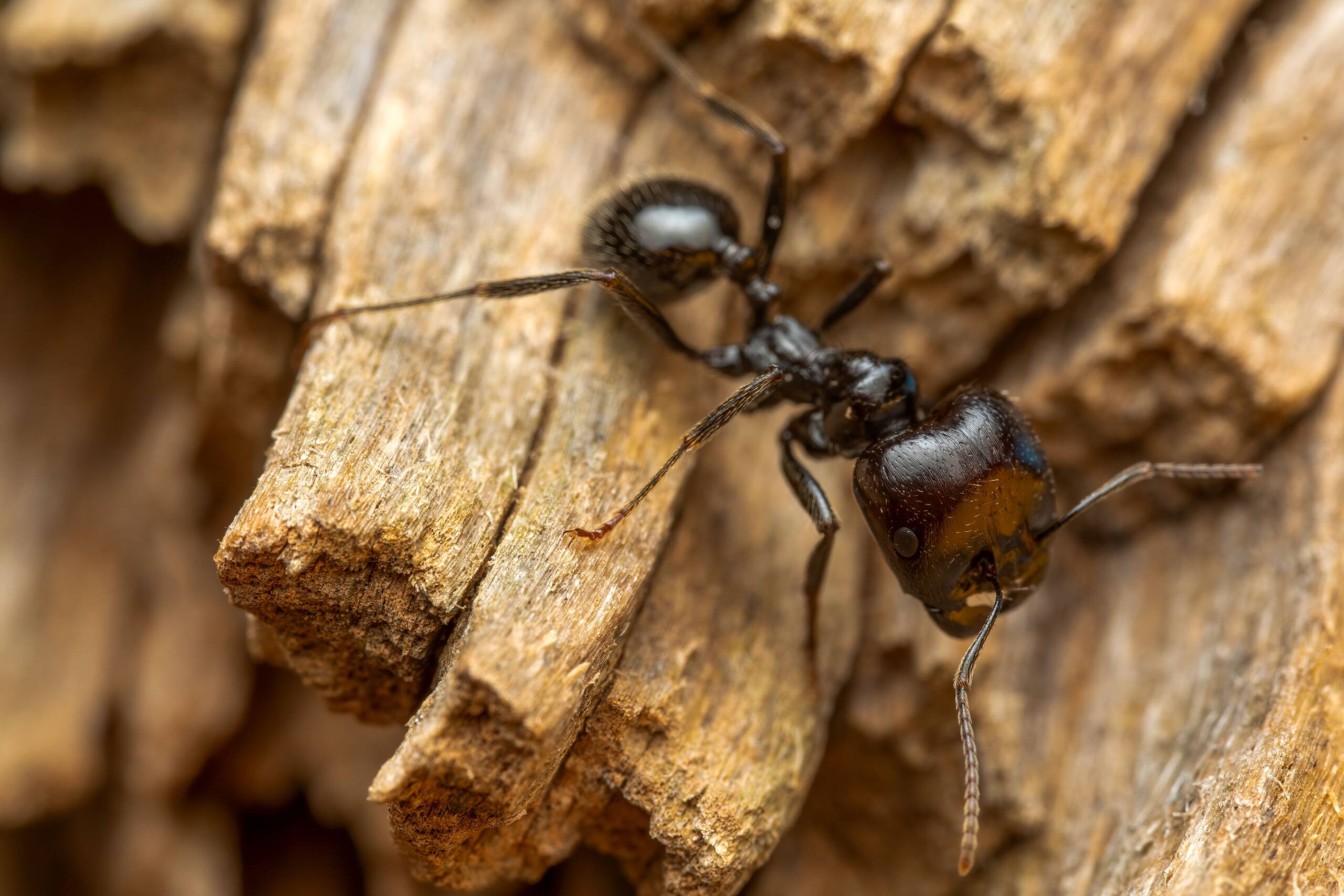
Carpenter ants are wood-damaging pests that tunnel through damp or weakened timber to form their nests, making them a serious concern for homeowners. Although they do not eat wood, their nesting activity can weaken structural materials over time. The carpenter ant queen is the foundation of every colony, responsible for reproduction and long-term survival. Understanding her role helps identify infestations, explains rapid colony growth, and shows why professional treatment is essential for complete and lasting control.
Physical Characteristics and Role of Carpenter Ant Queen
The carpenter ant queen is considerably larger than the worker ants and has a very strong and rounded body. She is typically dark brown to black in color, and may retain wing scars from moulting. The main role is egg-laying, which help them to grow and sustain the colony. It can take a healthy queen many years to live and she can raise thousands of ants in her life. Worker ants take care of young larvae.
Hence, the colony would be unable to grow or replace lost workers without the queen. After forming the nest, she seldom leaves it. The queen remains concealed and this means that homeowners may never see her. Thus, it is important to have an inspection to stop sugar ants from coming and tolocate the colony and prevent further infestations from occurring.
How Do Queen Ant Starts Colony?
Once the carpenter ant queen has mated, she looks for an appropriate nest site that has warm, moist wood for the colony to start. To help her adjust to the world without wings, she takes them off her. She lays her first clutch of eggs in a protected area and incubates them and takes care of them by herself. As the eggs hatch, the young workers develop, feed and guard the queen.
Above all, as more workers develop the queen lays only eggs. The colony increases in size each season. Eventually, thousands of carpenter ants can be under the control of the queen. This early colony growth is often concealed, and may not be detected until when homeowners notice damage to the property. Once they start forming colony, take quick action of ant and insects control.
Signs You May Have a Carpenter Ant Queen Nearby
Large Winged Ants Indoors
If you spot large winged carpenter ants in your house in the spring, it may be a queen looking for a nest site. These are reproductive ants which appear before new colonies start. Multiple winged ants in your home should never be disregarded as it could indicate nearby activity.
Small Piles of Wood Shavings
Carpenter ants tunnel into or chew away damaged wood. There are small piles of wood shavings like sawdust that remain. If fresh wood debris has accumulated around windows, doors or baseboards, it could mean that there is a nest area in the vicinity that is inhabited by an active queen and workers.
Rustling Sounds Inside Walls
They can produce quiet rustling, or even faint clicking noises, within the walls as they tunnel. The colony continues to grow and the ants attend to the queen. Some of these weird noises are more distinct at night when there is less noise in the house.
Regular Worker Ant Activity
Many homeowners miss out to understand why are there more ants in my house as summer comes. If you continue to find worker carpenter ants in the same places, frequently in kitchens, bathrooms or moist wood, that could indicate an ant nest is nearby. Workers are in constant movement from food source to colony. If the activity is regular, then the queen is producing new ants all the time.
Common Places Queen Ants Build Nests
Carpenter ants like to nest in soft, decaying or moist wood, which makes it easier to bore into. Wall voids, wooden beams, window frames, roof spaces, crawl spaces, decks, fences, tree stumps and old logs are common nesting locations. Over moistened houses, leaking pipes and torn roof provide ideal nesting conditions. If you are unable to control any huge infestation, it is better to hire expert ant control services in London On.
The queen is always kept well protected in the nest where the worker ants can safely protect the queen and her eggs. They are very sensitive to open spaces and bright light if possible. Early detection of these hidden nests helps to avoid larger colonies, expensive structural damage and continued carpenter ant infestations of your property.
Surprising Facts About Queen Ants You Should Know
Queens Can Live for Years
A queen’s lifespan is very long compared to the lifespan of worker ants. The lifespan of many queens is long (several years), and they lay eggs on a continuous basis. They have a long life and their colonies grow in a steady manner making them harder to control other than by getting rid of the queen from the nest entirely.
One Queen Creates Thousands of Ants
One carpenter queen can give rise to thousands of carpenter ants during her lifetime. As the colony grows, the workers collect food, defend the nest, and add tunnels. This continual reproduction is what makes any small infestation so easy to turn into a big problem.
Queens Stay Hidden Most Times
Carpenter ant queens don’t venture far from their colony. The worker ants feed the larvae within the concealed rooms and guard them. Since queens are not visible, infestations are frequently not detected at early stages. Inspection of your property is a key component in the process of ant removal Bradford.
Colonies Can Have Satellite Nests
Satellite nests of large colonies are often in place and are linked with the main nest. The worker ants carry out foraging trips between these and the main queen stays in the original nest. If the nests being removed are “satellite nests,” the queen will still be laying eggs, so the infestation will not be cured by removing only satellite nests.
Eliminate Carpenter Ant Colonies with MVO Pest Control
A carpenter ant infestation will continue as long as the queen remains active. At MVO Pest Control, our experienced technicians perform thorough inspections, locate hidden nests, eliminate carpenter ant queens, and provide lasting prevention solutions. We use safe, effective treatments designed to protect your home and family while stopping colonies from returning.